My work

No. 1 free app on Taiwan’s App Store

40,000+ downloads

One button gives an unclear feeling a simple action.

A small demo found
a place in other people’s lives.

Panic Tracker

A small, tactile way to acknowledge an abstract feeling

No. 2 free app on Taiwan’s App Store

20,000+ downloads

My parents’ recurring idea became a ritual you can perform with a finger.

“That button could
become joss paper.”

Paper Gold

A Taiwanese ritual reimagined for a screen

No need to summarize your day. Just say what you were doing.

A month of journaling
started with one sentence.

What Are You Doing?

One sentence at a time, a record of your day

Design and collaboration

Leaving the design file to hear how students find courses and services.

The interface is ready.
Can students find their way?

NTU information services

Interfaces and open design resources

From woven patterns to overlapping squares, giving collaboration a form.

A book we made together.
A reason to reconnect.

Plurality

Collaborative visual design

Handing over a design also means giving others a way to continue.

We want to build it together.
Who can carry it forward?

vTaiwan

Visual identity and web interfaces

A forest story offers a way into questions of digital identity.

When friends scatter,
how do we find each other again?

Bond

Story and demonstration prototype

Make a way in, so someone can experience a new possibility.

Life could
be like this, too.

Studio Binoki

Software, writing, visual experiments

iPhone App

GetApp Store ↗

Read the original making-of essay

About the app

How to use this app

Key features

    When to use it

    Data and privacy

    How to get it

    App Store name: · View on the App Store ↗

    In the press

      Leaving the design file to hear how students find courses and services.

      The interface is ready.
      Can students find their way?

      NTU information services

      Interfaces and open design resources

      I study economics at NTPU. Can I join, too?

      How I joined the team

      When I first started university, I didn’t have a clear goal for my life. I was studying economics at National Taipei University, knew a little design, and had participated in some projects in the g0v community. But I still didn’t know where those experiences might take me.

      Later, I met an older student online, and we talked about an opportunity to join a team working on NTU’s university administration systems. My first reaction was surprise: “I study economics at NTPU. Can I really join the team at NTU? How could an opportunity this good exist?”

      At the time, working on systems that people at NTU would actually use was an opportunity I hadn’t imagined. The team looked at things I had made in g0v, thought I might be able to take on the work, and asked whether I wanted to come.

      They happened to need help, and I happened to be looking for a chance to try something. I wasn’t thinking very far ahead. If someone was willing to invite me to work with them, I wanted to see what I could contribute. There were also more experienced designers on the team to guide us, so I could learn as I worked. I said yes.

      And so, a student studying economics at NTPU, who made things in an open-source community in his spare time, began working on NTU’s administrative systems. The projects I had shared within that community took on a new role: they gave people who barely knew me a reason to believe I could handle the work.

      The Office of Academic Affairs and the team drove the overall effort. My work included the course website, the transfer examination application system, the teaching evaluation administration interface used by the Curriculum Division, and the Experience NTU open-source design system. I didn’t design every NTU website, and I didn’t do this work alone.

      What happens when a design decision reaches a student?

      My understanding of design work was quite concrete: organize requirements, open Figma, arrange the screens, and hand things over to the people responsible for implementation. A process I can now describe in a few sentences took a lot of time back then. Where a button should go, what order information should appear in, whether an icon would make sense—each needed attention.

      University systems have their own complications. Students come to look up courses, plan their schedules, and get things done. They usually can’t switch to another provider simply because they dislike the interface. A small decision in a design file can determine whether someone finds the information they need or completes the task in front of them.

      Our engineering teammates worked hard to make the systems run better. I gradually encountered another kind of problem: things on a screen can mean different things to different people. An icon might seem right for a particular field, yet already mean something else in another context. The categories in our design files might not be the categories a student thinks of when looking for information.

      From design files to students’ lives

      These questions were difficult to answer just by staying at our desks and thinking. So I began talking with students.

      Today, “talking with students” might suggest a carefully planned research program. In practice, I often just wanted to practice interviewing: find someone to sit down with, ask how they normally used these services, and hear what they had encountered. I took notes and arranged interviews, but much of the work still felt basic and piecemeal.

      Once, a student told me that when he needed a university service, he often went straight to Google. I had assumed that certain university portals already brought together plenty of information. But as we searched together, I discovered a gap between “there’s a link on the website” and “a student can find what they need.” That conversation also raised questions about using the new course website on a phone. These comments weren’t necessarily easy to hear, but they made the circumstances beyond the screen tangible. Public conversation notes

      Looking only at a design file, I could easily think the work was done: the information was there, the entry points were drawn, and the features existed. But the student was describing a different experience. He was preparing to choose courses, looking for resources, and managing his life. The system was just one place he had to pass through along the way. Following his sequence instead of mine helped me see what I had missed.

      Making the work approachable

      I also began keeping records of these conversations.

      In the public collaborative notes, I introduced myself as “Tofus, a student worker at the Office of Academic Affairs” and proposed an open space for conversation. Students could ask about university systems, work alongside me, and help edit the records. The document also recorded something that frustrated me at the time: feedback was often fragmented. It was easy to receive a complaint and change one thing without having enough context to understand how the problem had arisen. Project description for the collaborative notes

      Looking back, that document did something subtler than preserve notes: it made work that had been hidden within the team recognizable and approachable to other people.

      “There’s a group updating the systems” is still vague. But when a document names a person responsible, explains what people can discuss, and shows how they can contribute to the records, students have someone they can reach. They know whom to ask, and that what they say might be recorded. Putting my name there also meant that I needed to take questions, organize information, and explain the work.

      In 2023, I also presented the Experience NTU open-source design system at a g0v hackathon. Taking design materials beyond the team, so others could see what we had made and how to access it, was another concrete way to share the work. The original public talk registration records the title and my name.
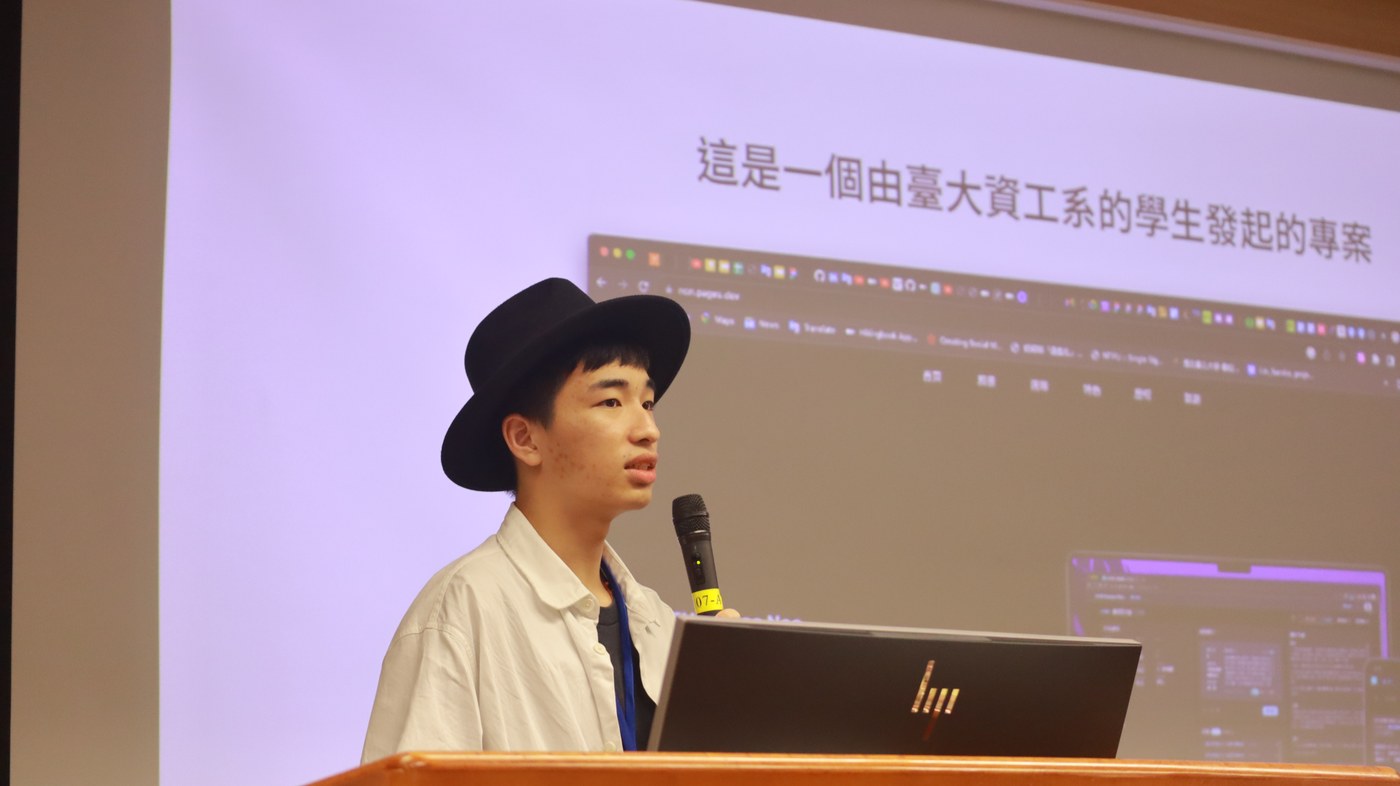
      Tofus Wang, wearing a black hat and white shirt, speaks into a microphone behind a lectern. The projection introduces a project initiated by NTU computer science students.
      On August 26, 2023, I introduced the NTU project at a g0v hackathon. The projection behind me describes a project initiated by NTU computer science students. Taking our design work beyond the team and explaining it to others was part of the job, too.Photo: Yi / g0v.tw. Resized; no cropping. · Photo source · CC BY 2.0

      Only later did I understand the value of those basic tasks

      I now understand more clearly why these forms matter. A public name, a record of a conversation, an act of listening—over time, they can give people a sense that this office is willing to communicate, that they can ask questions, and that users’ experiences deserve to be brought back into the discussion.

      I wasn’t thinking about all of this every day back then. I was still absorbed in drawing UI, arranging interviews, and organizing material. Sometimes, I wasn’t even sure what those tasks changed beyond leaving more documents behind.

      Later, friends I knew in student government spoke very positively about the Office of Academic Affairs during that period. What they had experienced was openness and a willingness to engage with students. Hearing their feedback helped me see the everyday work I had contributed to in a new way.

      I can’t take all the credit for that assessment. The commitment to openness, the services our engineering teammates built, and the efforts of other designers and colleagues all played a part. What I do know is that talking with people, recording their comments, and explaining the work publicly were my ways of participating. Tasks that had seemed basic to me later became part of how others understood the team.

      How design’s influence grows beyond the screen

      This also changed how I measured design.

      I used to judge my work mainly through the screens: were they good enough, did the flow make sense, and how much had I delivered? My experience at NTU made me notice that once work is handed over, it enters another world. People ask: Why was this changed? Whose needs were considered? Who can I contact when something goes wrong? Is there somewhere for my feedback to go?

      These questions affect whether something is accepted, and whether people are willing to participate again. To contribute here, a designer needs to step beyond the screen, understand the circumstances of different people, and make their own work open to questions.

      I became interested in a kind of work that brings out what makers and users struggle to see about each other, then turns it into material they can discuss together. It requires drawing, but also asking questions, writing, explaining, and repeatedly making real contact with people.

      At the beginning, I had simply said yes to an older student and gone to see how I could help. By the time I left this work, I had begun carrying a different question: when people don’t yet understand something, or don’t know how they can participate, can I create a way in that is easier to approach?

      Later, that way in sometimes took the form of an image, sometimes a story, and sometimes an app someone could hold in their hands and use.
      From woven patterns to overlapping squares, giving collaboration a form.

      A book we made together.
      A reason to reconnect.

      Plurality

      Collaborative visual design

      I came to design a book cover, and discovered that a book can hold relationships

      When I first joined Plurality, I wasn't thinking very far ahead. I heard in the community that Audrey Tang was writing a book and inviting people to take part, so I joined the discussion group. There, I saw a cover made with generative AI. I thought we could try something else, and drew an alternative myself.

      That unsolicited contribution opened the door to further discussions, and I took on the work of exploring the book's visual identity. Plurality is about digital technology and collaboration, and was itself made by people from many different backgrounds. My task was to find a recognizable visual form for ideas that were difficult to explain in a single image.

      An idea on screen still has to pass through paper and print

      At first, I instinctively used weaving and color to express the meeting of different perspectives. Colors could form a spectrum; interwoven lines could suggest many people working together. I followed that imagination until I ran into a practical constraint: the image was too complex, and difficult to accommodate within the printing budget and production process.

      It was the first time I clearly felt that a design had to work beyond the screen. A book that would actually be printed and held in someone's hands had its own production conditions. The more I wanted to include, the more carefully I had to decide what deserved to stay.

      Later, through discussions with Audrey and the team, the visual direction gradually settled around “⿻,” two overlapping squares. I continued experimenting with dots, symbols, and color to bring together imagery of digital technology and collaboration. I didn't decide on the logo alone, and we didn't arrive at an answer in one attempt. Through working together, it gradually became something we could deliver.

      In 2024, I submitted three dark logo SVGs to the book's public repository, and they were later merged. The public delivery record preserves those files, while the official acknowledgments list me alongside other contributors to the visual design.

      Abstract ideas gained an image we could talk about

      I also brought ChenYuluoyan, a typeface a friend helped create, into the visual design. This open-source typeface came from very young creators. In my mind, that formed another connection with the book's collaborative production.

      Later, someone sent word that the related visuals had been used in Michael Sandel's class at Harvard. One of the things that made me happiest was being able to tell my friend: your typeface appeared in a place like that. It didn't mean every viewer understood the symbol, or that the visual design was beyond improvement. But something we had made with our own hands had reached a place we hadn't imagined.

      Looking back, what we were doing felt like weaving information into an image. Ideas that had been abstract, with nothing to compare them to, became something people could point at and discuss. They could describe it, explain it, and connect their own understanding to it. I began to feel curious about this work of giving complex meanings a form.

      A book can also give us a reason to get back in touch

      After the work was finished, the more lasting discovery happened in the relationships between people.

      Official Plurality author-page photograph of Glen Weyl and Audrey Tang standing side by side with raised hands.
      A photograph of co-authors Glen Weyl and Audrey Tang used on the official Plurality author page. They made the book with contributors from many places.Source: the official Plurality book repository; photographer not credited. Resized; no cropping. · Photo source · CC0 1.0

      Not everyone around me could explain everything in the book. There were many contributors, and each had worked on different parts. Yet that was precisely why it could so easily open a conversation over a meal or at a reading group: “What did you write? What did you draw?” From there, we would start talking about the questions that mattered to each of us, and what else we could do together.

      My connections with some friends in Japan have also been sustained by our shared involvement in Plurality. Even after some time has passed, when I don't know how to start a conversation again, I can still say: “We both contributed to this book.” Having our names on the same work gives the relationship something concrete to return to.

      I used to think of books more readily as a one-way medium: someone writes, someone reads. This time, I discovered that a book made by many people can also be a tool for social connection. It preserves its contents, but also the memory that we once made something together.

      It reminds me of chatting with classmates in a shared Google document when I was young. With paper, credits, and a longer shared commitment, Plurality made that kind of shared space more tangible. For me, this also connects to the question of memory in Civilization: relationships depend on memory, and shared memories can give a community reasons to keep meeting.

      Plurality
      The Mandarin logo version submitted to the public repository in PR #977.

      Handing over a design also means giving others a way to continue.

      We want to build it together.
      Who can carry it forward?

      vTaiwan

      Visual identity and web interfaces

      When people want to work together, they still need a way to carry the work forward

      At g0v, I often come across interesting projects that people have already put a great deal of work into. vTaiwan is one of them: people from different backgrounds work together to create space for discussing public issues. I wanted to update its design, but soon encountered a problem more practical than the interface itself—everyone had their own work, and there weren't enough people available to rebuild the entire website.

      I wrote about this in an article from that time. Some civic technology projects have received many contributions, yet the people maintaining them don't necessarily have time to take on new engineering work. Knowing what you want to change and having someone who can keep doing the work are two different conditions.

      Sharing something made it possible to see what was still missing

      I first made a prototype that the others could see. The public collaboration record from April 2025 documents this process: I shared a preview deployment, Joey invited everyone to look for problems and pointed out that the mobile navigation button wasn't displaying properly, and Ronny explained how the existing website retrieved its issue data.

      Thumbnail of a public vTaiwan gathering video, showing participants around a table with laptops, a projector and cables.
      The thumbnail of a vTaiwan gathering video I publicly shared on April 1, 2025. Laptops and a projection sit around the table as participants look at screens and work together—a scene preserved from that period of collaboration.Source: published video thumbnail from Tofus Wang. · Video source

      Once the prototype was shared, the problems became concrete. Could people use the interface on their phones? Where would the issue data come from? Who could update the content? A polished design mockup alone could hardly answer these questions, and people's willingness to collaborate wouldn't make them disappear.

      Later, I switched to a tool with a more complete content management system, so the others could start publishing content. That choice is also documented in the same public record. It didn't necessarily deliver the entire new website we had imagined, but it met something the community needed to do right then.

      The delivery involved more than a finished image

      The subsequent design work gradually produced a logo, colors, typography, components, and interactive page prototypes. I organized them into a public design handoff package, so the others could see the design decisions and have materials to work with.

      The public design conversation also shows my revisions to the cards, cues for clicking, typography, and component consistency. AI could help generate things, but someone still had to keep judging what felt awkward, what left people unsure whether they could click, and which rules needed to change together.

      The others then brought the new visuals into the existing website. The public implementation task explicitly names my designs as the reference, with components, responsive behavior, and multilingual layouts addressed piece by piece. This record also reminds me that a prototype, a handoff package, and a live website are separate pieces of work to complete. The site's engineering and ongoing maintenance were the result of other collaborators' efforts too.

      Giving things a chance to keep happening

      Looking back, I began to care more about whether someone else could continue using a design after I handed it over. People need to know where the files are, how to modify them, and what content they can update. They also need the time and the means to maintain it.

      My work at NTU showed me how communication helps people understand an update. vTaiwan took the question to the next stage of collaboration: once everyone understands and wants to work together, how can the work continue?

      The early attempts to update older projects were also part of the context in which I began experimenting with AI-assisted development. When it was difficult to wait for implementation help, I wanted to know whether I could make something myself first, so discussion and experimentation could keep moving. The small Panic Tracker demo began in that situation.

      vTaiwan

      A forest story offers a way into questions of digital identity.

      When friends scatter,
      how do we find each other again?

      Bond

      Story and demonstration prototype

      A story as a way into an institution that does not yet exist

      After seeing Panic Tracker, Mashbean reached out to talk about a digital identity project and invited me to join. By then, I could already make some things with AI. The task was concrete: build a mockup we could demonstrate before the workshop.

      Digital identity involves credentials, trust, privacy, and verification. But if we begin with zero-knowledge proofs, people unfamiliar with the technology may struggle to see what any of it has to do with their lives. We needed a situation we could imagine together first.

      How can the forest friends prepare before the bear arrives?

      Bond’s public website tells a forest story. A squirrel hears that a bear might threaten the forest and asks the bees how to prepare. The bees offer small sealed jars where the animals can keep their own belongings and tokens from their friends.

      The squirrel leaves a paw print on a pine cone and exchanges tokens with a rabbit and other animals. When the bear arrives and everyone scatters, the pine cone in the rabbit’s jar helps the rabbit recognize the squirrel again. The things they once exchanged become clues that help friends find one another.

      I generated this story with ChatGPT. I have already forgotten some of the early discussions and who first suggested each idea, so I would not claim that every concept began with me. But the story gave the team a shared situation: people could understand preparing, keeping things safe, and recognizing their friends again before discussing identity backup, credibility, and privacy.

      A speaker holds a microphone beside a projection showing BOND, its Chinese name, and a forest-animal visual.
      The Bond team presents at the g0v disaster resilience hackathon on September 21, 2025. Its projected forest-animal visual introduces the identity backup proposal.Photo: daisuke / g0v.tw. Resized; no cropping. · Photo source · CC BY-SA 4.0

      The story turned an abstract institutional question into a situation people could put themselves in. “If I lived in this forest, what would I need to leave behind? How would someone else know it was really me?” Questions like these make it easier to begin a conversation than a string of technical terms.

      A demonstration is still a long way from reliable use by many people

      I completed the demonstration prototype and shared the idea at the workshop. At the time, though, it was not a tool we could hand over to many people for everyday use. The verification behind digital identity is complex, especially when it involves zero-knowledge proofs. The AI and production methods available to me then could not reliably complete that technical work from end to end.

      This experience made me feel the limits of no-code tools and making things with AI. An interface you can operate and a concept you can demonstrate do not mean an entire institution is ready to function. The team’s public presentation on its development philosophy also asks about data authenticity, selective disclosure, and the conditions for trust. Those questions require work of their own; a story cannot resolve them.

      A prototype can also be an essay in software

      Even before becoming a mature tool, the prototype could communicate something. It was like an essay in software: it placed an idea in front of others, letting them imagine what they might do instead of only listening to an explanation.

      Participants at the g0v hackathon watch the Bond team’s public presentation, with BOND visible on the front projection.
      A wider view of the same public presentation, with participants watching the introduction to Bond. It records the team bringing its identity backup proposal to the community.Photo: daisuke / g0v.tw. Resized; no cropping. · Photo source · CC BY-SA 4.0

      Panic Tracker showed me how a work could enter people’s daily lives. Bond brought me closer to another kind of work: making an entry point for discussing an institution that had yet to take shape. The story and prototype were not final answers, but they let people place themselves in the situation and ask questions that would otherwise be difficult to articulate.

      The experience left me with two things to assess separately: whether we helped people begin to imagine, and whether we actually built an institution they could reliably use. The first is worth making. The second still needs technology, collaboration, and verification to move forward.

      Make a way in, so someone can experience a new possibility.

      Life could
      be like this, too.

      Studio Binoki

      Software, writing, visual experiments

      Make an entrance to “Life could be like this, too”

      Studio Binoki is my creative studio for software, writing, and visual experiments. These works can look very different: a button, a book's visual identity, or an essay that asks to be read slowly.

      What I hope they offer is a possibility someone can enter for themselves: “Life could be like this, too.” That phrase needs concrete work behind it. What someone can do, what responds to their action, and what experience remains must be answered again through each act of making.

      From completing a work to understanding what it makes possible

      My work at NTU showed me that a finished interface also needs contact with different people, so that a change can be understood. Plurality showed me how a shared work can hold a shared memory and give relationships a reason to reconnect.

      Panic Tracker entered everyday lives I could not see; What Are You Doing? helped me keep a diary I had never imagined maintaining. Bond let me discuss a proposed institution through a story and prototype. Paper Gold brought a familiar cultural form into a phone and left me with new questions about local cooperation.

      These experiences did not begin with one blueprint. Through making, using, hearing responses, and looking back, I gradually discovered the questions I wanted to keep asking.

      Life experiences need to be made, too

      In “Developers of Life Experiences”, I considered film, music, and software as related forms of work: creators can give human experiences forms that strangers can approach and practice.

      Published opening photograph from Developers of Lived Experience, showing a person on the steps in front of the National Palace Museum.
      The photograph published at the beginning of Developers of Lived Experience, taken at the National Palace Museum in Taipei. The essay brings film, music and software into a shared inquiry about making lived experiences.Photo: Mu Ke, as credited in the original essay. Resized; no cropping. · Photo source

      Software is particularly able to arrange actions someone can take. But what those actions leave behind is not decided by the creator alone. People have their own lives, purposes, and interpretations. A work needs room for them to use it, revise it, and discover meanings I did not anticipate.

      AI makes it easier to begin making, and makes judgment no less necessary. I need to explain what I want to happen, examine whether a generated form serves that purpose, accept when it does not, and keep revising. The studio is a place where I can return to those attempts.

      Leave the exploration somewhere others can join it

      Civilization carries the question outward: how did the world we wear, read, watch, inhabit, and use become what it is? Which forms give people a chance to act, and which conditions limit their possibilities?

      I still make designs. Through these works, however, what I want to understand and modify has extended from screens to how people live. Studio Binoki holds this continuing exploration of making, using, and asking. It also gives me a place to invite others to discover and try new possibilities.

      Studio Binoki